

Morning at the Rack
By 8:40 on a collection morning, the rack beside my building’s entrance is already full. Half an hour earlier, it was empty. Japanese garbage day, on this street at least, is a rush: the bags come down all at once, the net goes back over each one, and it is done before most people leave for work. A white cat sometimes sits on the metal bars and watches the whole thing.
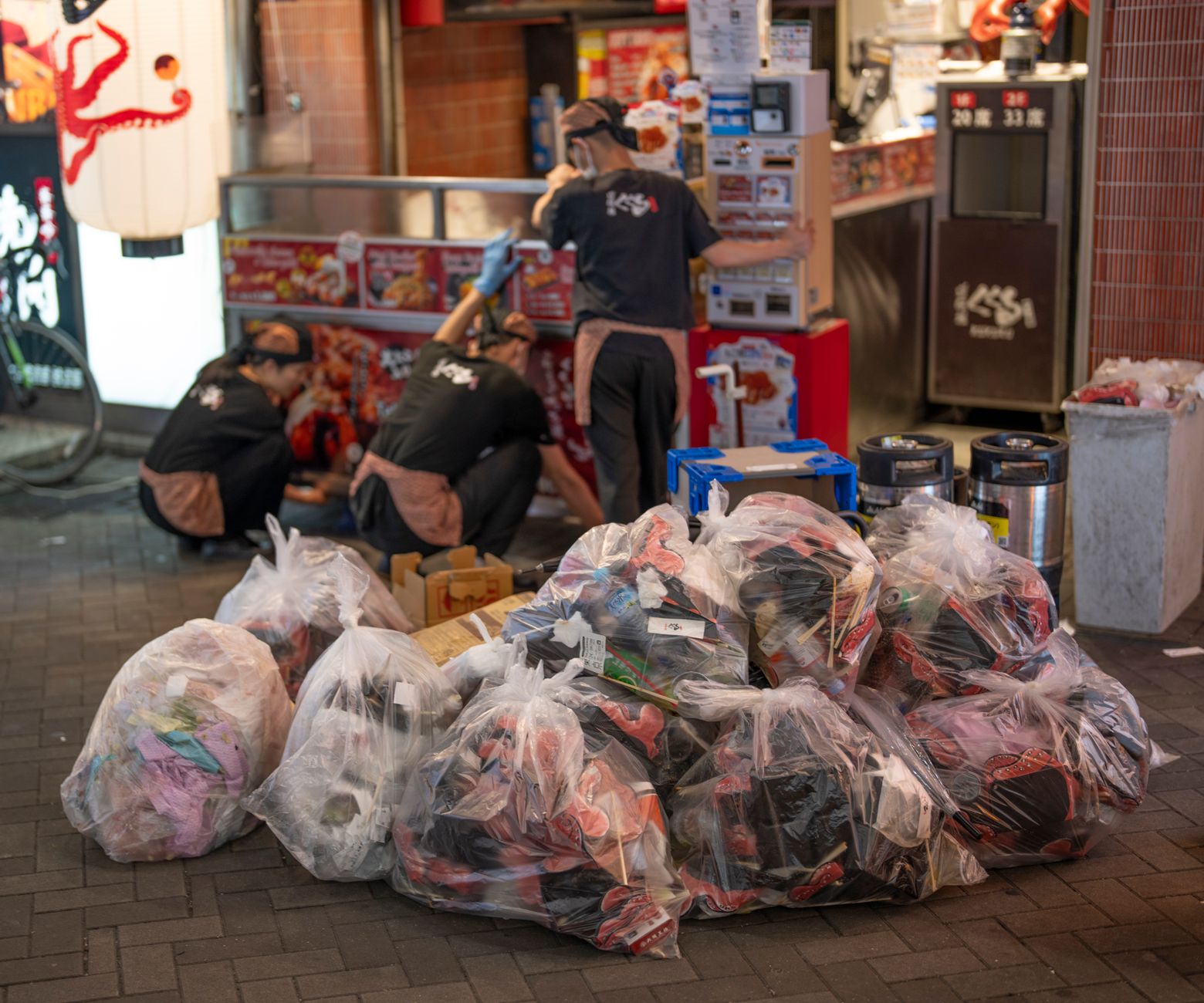
This is one building in one ward of Osaka City, not a claim about the whole country. The rules here are municipal. They differ from ward to ward and city to city. What follows is the routine seen from this doorway on a normal week.
Japanese has a plain word for garbage: gomi (ゴミ). Garbage day is gomi no hi. Nobody in the building says it out loud, though. The bags and the net make the day obvious, and the calendar in the entrance does the rest.
On a regular garbage morning, most of what goes down is kitchen waste and small plastics. People carry the bags by the knot, not by the top. A few neighbours wear slippers. One or two are already in work clothes. The whole exchange takes less than ten minutes.
The rack itself is a low metal frame, nothing like a dumpster. It sits at the side of the entrance, open to the street. There is no lock and no lid. The net is the only barrier between a bag and the crows.
What One Week Asks of a Household
Osaka City sorts household waste into five broad groups. Regular garbage goes out twice a week. In this building, those two mornings usually fall on weekdays, though the schedule is set by neighbourhood. The city website and the San-R app give the exact days for an address.
Some categories show up on their own days. Not every category appears every week. A week with no bottles or cans is normal here. The only thing that must be right is the bag type, the category, and the morning.
Osaka City does not require official paid city bags, as of 2026. The rule is clear or semi-transparent bags. Opaque black bags, or solid-coloured ones, are not allowed. A dark bag left on the rack can simply sit there. It gets passed over, not collected.
Back where I grew up, garbage day meant wheeling a bin to the curb. Here, there is no bin. Bags wait inside the apartment. The current day’s bag sits in a small corner by the kitchen, not outside. In between collection days, it stays in the unit.
Recyclables go out in their own transparent bags, usually on a different morning. The bag is lighter and often noisier. It crinkles the same way a bin liner does at home, but it is going to a rack, not a cart.
The Net, the Crows, and the 9:00 a.m. Rule
The collection point is a shared metal rack at the edge of the property. Ours has a heavy mesh net, usually blue or yellow. Most collection points in the city use the same setup. The routine is lift the net, place the bag underneath, and pull the net back over it.
The net is not there to keep people out. It is there to stop crows from ripping bags open before the truck arrives. The city’s guidance says putting bags out the night before can lead to crows making a mess. So the rule, as of 2026, is to put everything out on the morning of collection day by 9:00 a.m.
In practice, the rack fills between 8:00 and 8:50. A few people come down in bath slippers. The net gets lifted and replaced over and over. It is not a chore anyone lingers on. By 9:10, the bags are gone and the rack is empty again.
In summer, the bag waits inside the apartment. The kitchen bin fills faster. People empty it more often, not because the bag is heavy, but because the indoor air turns quickly. Air conditioning helps, but only until the morning. By then the small bin by the sink has a smell of its own, and nobody in my apartment wants to carry it down any later than they have to.
What Happens to a Bag on the Wrong Day
If a regular bag goes out on a recyclables day, it generally stays. The collectors take what matches that day. A bag at the wrong time, or in the wrong spot, can sit under the net until someone moves it. This system does not quietly fix mistakes.
In this building, a wrong-day bag sometimes draws a note. More often it just waits. A neighbour may carry it back inside if the owner is known. Nobody gets fined for one mistake here, from what is seen. The cost is mostly inconvenience and a little embarrassment.
A chair left by the rack on a normal day will still be there in the evening. Furniture does not go out with the weekly bags. The daily net is for regular bags only. Oversized items sit outside the whole rhythm.
The truck crew can see through the bag. That is the point of the transparent rule. If a bag has the wrong contents, it gets left. A banana peel in a bottles bag is visible from the curb. It will still be there after the truck leaves.
Oversized Garbage Is a Different Routine
Anything with a longest side over 30 centimetres, or over one metre long, is not regular garbage in Osaka City. Furniture, bicycles, and futons all fall into this older, slower category. The threshold is specific, and it catches more than people expect.
The procedure is appointment-only. A resident books a collection, buys a disposal fee ticket at a convenience store or supermarket, and writes a name or reception number on it. The ticket goes on the item. On the appointment morning, the item goes out at the designated spot.
This does not line up with the weekly rhythm. It is a separate phone call or online booking, a separate fee, and a separate morning. A regular garbage day passes once or twice a week. Oversized collection happens once a booking is made, not before.
How a Newcomer Works It Out
The hardest part for me was not sorting. It was learning the rhythm without a single authoritative source in English at hand. The building posted a small chart near the entrance. It listed the days and categories for this address.
The San-R app ended most of the guesswork. A person types the item, and it tells the category and the collection day. The city website does the same by address. The app does not make the rules gentler, but it removes the memory part.
The ward office has a printed guide. Most people do not see it until they ask. It sits in a rack near the counter, next to tax forms and neighbourhood maps. The building chart is more useful day to day.
A newcomer sees the five groups and assumes the hard part is sorting. It is not. The hard part is the calendar. The same bag of kitchen scraps can be right on Tuesday and wrong on Wednesday. It depends on the week and the neighbourhood.
One Building, Not a National Rule
Every part of this is specific to Osaka City and to this building’s collection point. The next ward over may use different bags, different days, or a different app. Even within Osaka City, collection days are set per neighbourhood. This is one routine, not a claim about the whole country.
The rules also change. A fee or a procedure that is current in 2026 will not be current forever. Osaka City’s own guide tells residents to check by address, and that is the only safe habit. What stays the same is the shape of the week: small bags, shared racks, and no bins.
The routine is built for small spaces and shared points. It would look strange in a place with driveways and garages. It looks normal from this doorway now, which is its own quiet surprise. The net, the bags, the timing have all become ordinary.
Most people here could not tell you why the categories are split this way. They just grew up with it. That is true of a lot of things at home, too. Garbage day, seen up close, is just logistics with a net over it.
References
- 株式会社willow, “Osaka City Guide 2025: Your Ultimate Guide to Garbage Disposal” — the five-category split, collection-day lookup, 9:00 a.m. rule, transparent bag requirement, and oversized garbage threshold.
- Osakaa, “Osaka Garbage Guide” — the clear/semi-transparent bag rule and the mesh net coverage requirement.
- Osaka City website (city.osaka.lg.jp) — the official address lookup for ward-specific collection days.