

You Are Picturing the Hotel Tray
Ask someone outside Japan to name a Japanese breakfast, and the image is almost always a ryokan tray — rice, miso soup, a piece of grilled fish, a rolled omelet, and pickles, all arranged on lacquer. That tray is real. It just does not represent what happens before work. The weekday version is smaller, quicker, and much less arranged.
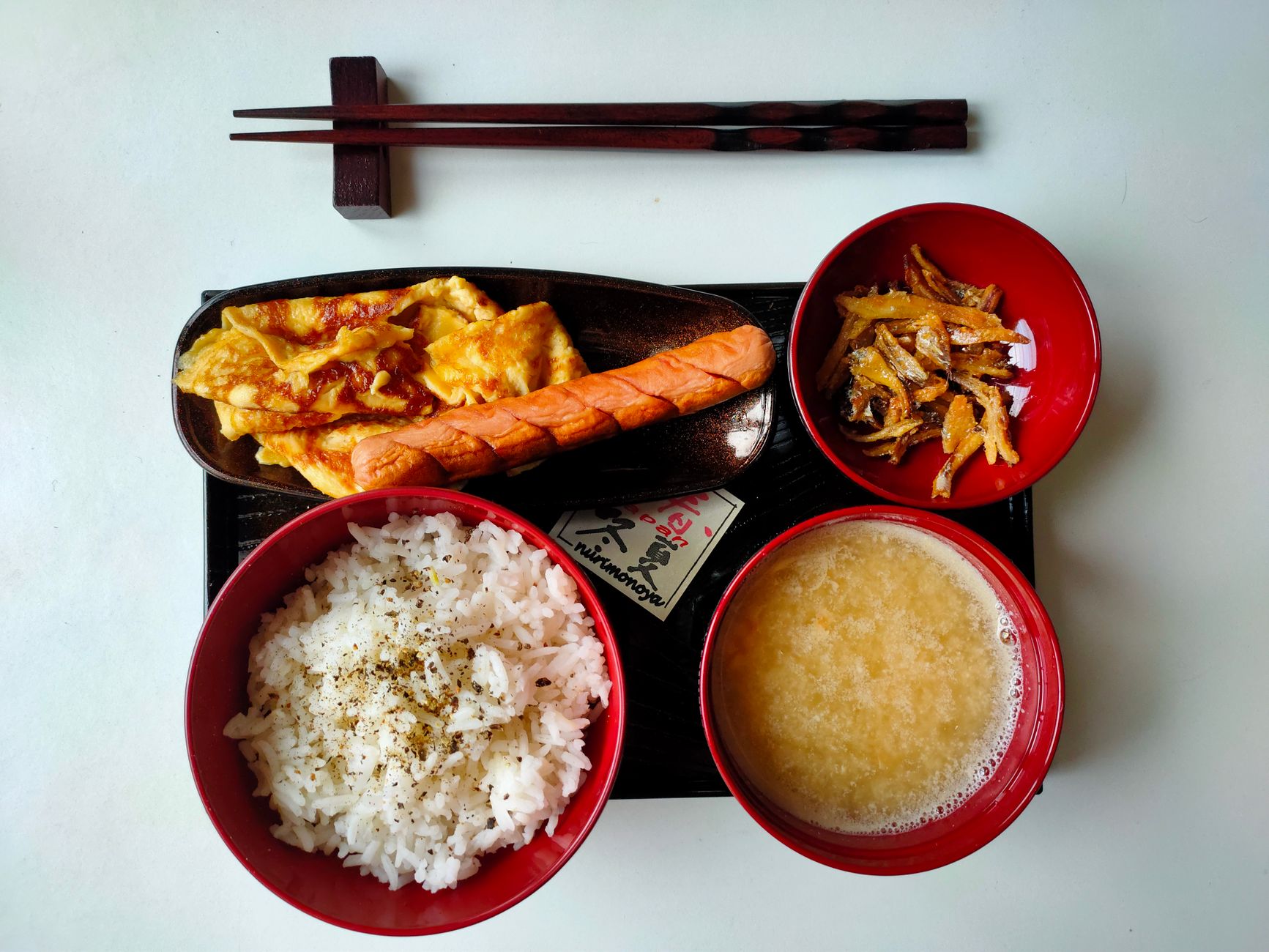
The first week I lived in Osaka, I kept waiting for that tray to show up. It never did. What I actually ate was whatever took the least time before the train: leftover rice, instant miso, and some mornings nothing but coffee and an onigiri from the konbini by the station.
The ordinary version is a bowl of rice and a cup of something, eaten in ten minutes while checking a phone. The hotel spread exists, but it is a special occasion, not a daily ritual, and it says very little about a random workday.
The Rice Side and the Bread Side
There is no single national breakfast. The same family can eat rice on Monday and toast on Wednesday. Both are ordinary. The word asagohan (朝ご飯) literally means “morning rice,” and it names the meal even when the plate holds bread.
The rice side is what most outsiders picture when they hear “traditional Japanese breakfast”: a bowl of white rice, miso soup, and something protein-based, with pickles or nori on the side. It is not a museum piece. In many homes, it still happens, especially when someone has a few extra minutes.
The bread side is faster. It usually means a thick slice of white bread called shokupan (食パン), lightly toasted, with butter, jam, or a mild spread. Coffee is standard. Maybe a boiled egg if there is time. This is a fully normal breakfast, not a Western import that replaced the real thing.
What Actually Sits on the Table
A rice breakfast is a collection of small dishes, not one plate with a single main thing. On a weekday, the pieces are mostly bought or made ahead. The only real cooking in the morning is reheating and assembling.
- Rice (gohan, ご飯) — cooked in a rice cooker, often set on a timer the night before. It can also be yesterday’s rice reheated in the microwave.
- Miso soup (miso shiru, 味噌汁) — made with dashi and miso paste, plus whatever is on hand: tofu, wakame, onion, or leftover vegetables.
- Protein — a small piece of grilled fish, a rolled omelet called tamagoyaki (卵焼き), or natto (納豆), the fermented soybeans that divide breakfast tables.
- Pickles (tsukemono, 漬物) — salty, sour, or lightly fermented vegetables. Most are store-bought, not made at home on a Tuesday.
- Nori (海苔) — thin sheets of dried seaweed used to wrap a bite of rice.
- Tea — green tea, barley tea, or sometimes just water. Coffee belongs to the bread side, but plenty of people drink both.
The traditional look is often just leftover management. The rice was set on a timer, the fish was grilled at the supermarket, the pickles came from a jar, and the soup uses instant dashi. It looks elaborate because it arrives in many small dishes, not because anyone was up early cooking.
This is the detail that surprises people. A breakfast that looks like a small feast can be assembled from refrigerator staples in under ten minutes. The labor happened days earlier, in a store kitchen or the previous night’s dinner. That is why it can still happen on a workday.
The Bread-and-Coffee Version
Among people in this part of Osaka, bread has become the default weekday breakfast in a lot of homes. The most common loaf is shokupan, a soft white bread sliced thicker than standard sandwich bread. It gets toasted and topped with butter, jam, or sometimes a thin layer of sweet red bean paste. Coffee comes from a machine, a pour-over, or a can from the vending machine. Nothing about it feels like a special occasion.
A thick slice and a cup of coffee are the whole meal. It sits on the same kitchen table where a rice breakfast might have been the day before. That back-and-forth is normal. The same person can eat both in the same week, and nobody treats it as a contradiction.
This version has the same short time commitment as the rice meal. It just uses fewer dishes. In some households, bread is the weekday choice because nobody wants to wash a soup bowl before leaving. That is not laziness; it is just the arithmetic of a morning.
What People Drink With Breakfast
Green tea shows up with the rice side, but not the elaborate matcha ceremony. It is usually a tea bag in a mug or a pot of hot barley tea. Cold barley tea in summer is common. Coffee belongs to the bread side, but it is not unusual to have coffee with rice either.
Milk appears with bread more than with rice. A glass of milk or a yogurt drink is an easy add for kids. A few older neighbors in this neighborhood drink hot water first thing; that is just something that happens.
Juice is not rare, but it is usually a small pour rather than a large glass. The drink is not the point of the meal. It is there to wash things down, not to be the meal itself. A cup of tea or coffee is enough.
Why the Morning Is Short
A weekday breakfast here tends to be small because the morning is not a long, seated event. People leave early, commute, and usually eat again at lunch. In local homes, breakfast is not treated as the most important meal of the day. It is something to put in your stomach before the train.
This is why so much of the food is ready in advance. The rice cooker has a timer, the miso soup is reheated, and the fish was cooked at the store with grill marks already on it. The person making breakfast is mostly assembling, not cooking. The meal is short because the morning is short.
Some people skip it entirely. A few coworkers drink only coffee until lunch. Others grab a rice ball from a convenience store on the way to the station. The idea that everyone sits down to a full set before work is an image from another context.
The portion sizes reflect this pace. A breakfast fish is often much smaller than a dinner portion. The bowl of rice is not heaped high. Nobody is expecting to feel uncomfortable by 8 a.m. The goal is to be full enough, not full.
The Rice Cooker Does the Morning Shift
In homes that eat rice, the rice cooker is the quiet machine that makes breakfast possible. A timer starts it before anyone wakes, so the rice is warm by the time the kitchen light goes on. The person making breakfast did not cook the rice. The machine did, hours ago.
This is one of those things that is easy to miss until you live with it. A pot of rice on the stove would demand attention. A rice cooker does not. That single difference explains why a rice breakfast can still happen on a workday. It also explains why bread can win so easily in homes where the rice cooker was not set.
The same logic applies to the miso soup. Instant dashi and a spoonful of miso paste turn hot water into soup in about five minutes. The tofu and wakame are already in the fridge. None of this is a process; it is a routine.
The Plate Back Home
Consider the plate from a Midwestern diner: one main item, maybe two sides. The rice breakfast here is closer to a spread of small dishes. None of them is large, but there are four or five of them. That makes the table look busier than it really is, and it makes the cooking look more involved than it is.
The bread-and-coffee meal, by contrast, is almost identical to a rushed school morning at home, just with a different kind of bread. The comparison only goes so far, though. The rice version is the one that keeps confusing people, because it looks ceremonial even when it is not.
Weekends and the Exceptions
Everything described so far covers a weekday. On weekends, breakfast can be later, bigger, or skipped altogether. Some families make pancakes or buy pastries from a bakery. Others go out for a morning set (モーニング, mōningu) at a coffee shop: toast, a boiled egg, and a small salad with coffee. That set is common enough to have a name, but it is not what most of the people in this area make at home on a Tuesday.
Some dishes vary by household, and a few vary by region. Natto is one of those foods. In some places it appears daily; in others it sits untouched in the supermarket. The same is true of certain pickles and the type of fish on the table. This is not a country where every kitchen opens the same way.
There are also people who eat the same thing every single day for years. A fried egg and rice, a particular brand of yogurt, a piece of toast with the same jam. Repetition is not frowned on. It is just a system that works.
The Practical Version Is Simpler Than It Looks
Most mornings are not a spread. They are a bowl, a cup, and something with protein. The full set appears more often on a day off or when someone has guests. That is the gap between the image and the ordinary day.
None of this is complicated once you have seen a few ordinary mornings. The only thing that surprises people is how much of the traditional look is just leftovers and store-bought pieces arranged in small dishes. The tray in the hotel is real. It is also a photograph of one particular morning, not a rule that every kitchen follows.