
The first time I saw a Japanese kitchen here, I stood in the doorway. I wanted to know where the rest of it was. There wasn’t a rest. There was a counter I could stand at, and not much more.
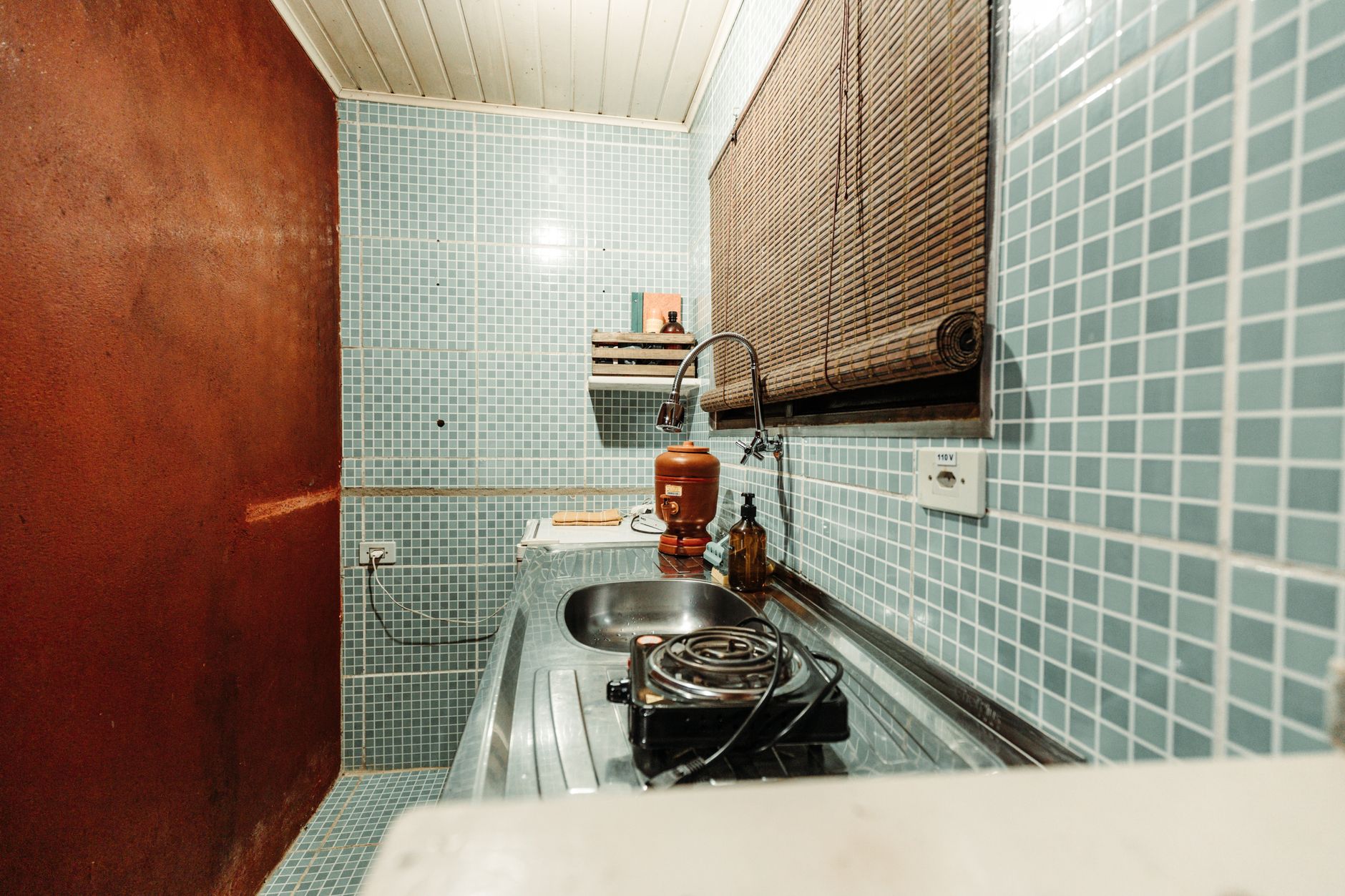
The Counter You Stand At
An ordinary apartment kitchen in my part of Osaka is a single line. You step in from the genkan or the main room, and everything is within reach. That is the design. There is no island, no breakfast bar, and no real place to back up.
The counter is deep enough for a cutting board and a drainer, and that’s about it. I have cooked in kitchens here where the workspace is smaller than the desk I had in an American office.
This is not a defect. It is what an apartment kitchen is. Every apartment I have seen gives the kitchen just enough room to cook, and no more. The ordinary Japanese home works the same way.
The Pieces, One by One
The hob is the first thing you notice. Most flats have two burners, sometimes three. Mine is a two-burner induction hob. There is no oven underneath it, the way I expected from home.
Below the hob there is a small drawer, or sometimes a door, that pulls out to reveal a fish grill. This is the part visitors always mistake for storage. It is not. It is a small, dedicated grill for fish. The first time I opened it, I thought the previous tenant had left a strange metal tray behind.
The sink is small but deep, with a rack that sits over part of it. You wash, you set the dish on the rack to drip. The rack is not a luxury. It is the drying system. There is usually no separate dish drainer, because there is no counter space for one.
Above the counter is a shallow cabinet. It holds the rice, the tea, the sauces. Below the counter are more cabinets, and sometimes a narrow drawer for chopsticks and spoons. A rice cooker has a permanent spot, often on a small shelf or on the counter under the cabinet, where its steam can rise without hitting anything.
The fridge stands taller than the counter, alongside it, not integrated. It is narrower than the American refrigerator I grew up with. In many older flats, it sits facing the kitchen from the main room, because the kitchen alcove cannot hold it.
The Washing Machine Sits in the Kitchen
In a lot of apartments, the washing machine is right there in the kitchen. Next to the sink, against the wall. It is not hidden in a laundry room. There is no laundry room.
I used to think it was strange until I lived with it. The kitchen is already where the water is. I assume that is why the machine ends up there. But I have never asked a plumber, and I am not going to pretend I know for certain. What I can say is that every flat I have seen in this price range has had the same setup.
The machine is a top-loader, usually, though front-loaders are getting more common. It drains into a pipe near the sink. Next to it, there is often a shelf or a small rack for detergent and a basket.
Wet and Dry, Brought Together
A Japanese apartment kitchen is part of a wet zone. The bath and the toilet are in their own separate rooms, and the kitchen is the other wet part. In a small flat, the kitchen often shares a wall with the bath or the toilet. I think that is partly why the washing machine ends up in the kitchen, but I’m not certain.
The toilet is typically its own tiny room, not in the bathroom. The bath is another room. The kitchen is not a place you linger, the way some American kitchens are. It is a place you cook, then leave.
Storage Logic: A Spot for Everything
Because the kitchen is small, everything has a place. There is a narrow drawer for chopsticks and cutlery. There is a shelf for the rice cooker. There is a spot for the bin, usually near the sink or under the counter.
The bin is not hidden in a cupboard. It is out, next to the counter, because that is where the waste is produced. In my old flat, the burnable bin sat directly under the edge of the counter. You could drop a vegetable peel into it without moving your feet.
This is not about minimalism. It is about a room where nothing can be out of place, because there is no spare space for it to be in. Every object either has a home or does not survive the week.
This Is an Ordinary Flat, Not a House
I should say plainly: this is what a rental apartment kitchen looks like. A farmhouse kitchen is a different animal, and a new build designed for a family can look more like something from a Western catalog. If you have seen photos of a Japanese kitchen with a central island, those are not this.
In an ordinary flat, there is no kitchen island. There is no open-plan great room. The kitchen is a corridor of counter, sink, hob, and fridge, closed off from the main room by a wall or a sliding partition. Sometimes there is a serving hatch, but not always.
When I mention the low tables and floor cushions in the main room, people often ask where the dining table goes. In many apartments, there isn’t one. You eat at the low table, or at a small table pushed against the wall, and the kitchen is just a few steps away.
A Comparison That Helps
Where I grew up, a kitchen opened onto a family room. There was an island, a double sink, a dishwasher, and cabinets that went to the ceiling. The refrigerator was wide enough that two people could stand with the doors open and still not touch.
Here, the refrigerator is narrow. The sink is small. The dishwasher is often absent, and when it exists, it is the size of a large microwave. The counter has room for one person at a time. Two people cooking together means one person stands behind the other and waits.
That sounds like a complaint. It isn’t. It is just a different set of trade-offs. The apartment is smaller, so the kitchen is smaller, and that is all. You learn to cook in stages. You prep, then you cook, then you wash, and each step happens in the same few square feet.
A Note on the Balcony
Out the kitchen window, or just past it, there is often a balcony. The balcony is not part of the kitchen, but it works with it. Laundry dries out there, and at certain times of day every balcony in the building is covered with poles and clips.
I will not pretend to know why everyone hangs laundry outside, but it is what you see. It is just one more thing the kitchen does not have to hold. There is no dryer, or the dryer is a small addition, so the balcony becomes the drying room.