

Most visitors to a Japanese home notice the habit only when they are halfway through it. Shoes come off before the floor changes, not after. What looks like an entryway is actually a line, and once a person crosses it, outside stays outside for good.
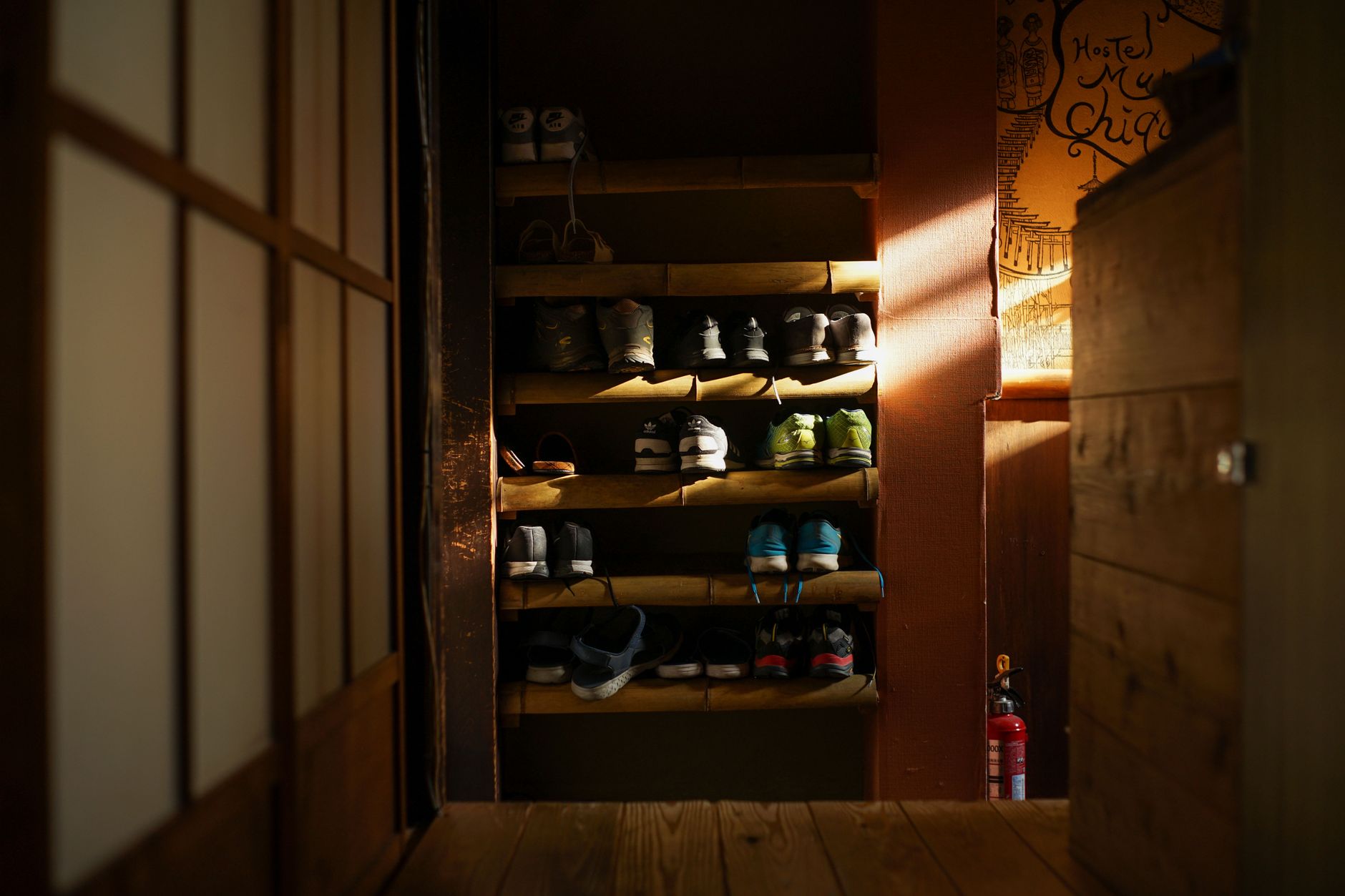
What Actually Happens at the Door
At the front door of a home, there is usually a step up from the entry area to the rest of the house. The lower part is the genkan (玄関), and that is where shoes stop. The raised floor is where bare feet, socks, or slippers take over.
The step matters because it makes the boundary physical. A person cannot carry a shoe past it without consciously deciding to. Shoes come off while the person is still standing on the lower level. Then they step up, and the outside has been left in the genkan.
Taking shoes off is only part of the habit. Most people turn them so the toes point toward the door. When it is time to leave, the shoes are already facing the direction a person will walk. It takes one extra second, and after a while it becomes automatic.
Guests are often offered slippers for the inside. They are not required everywhere. Some homes keep a shelf of them near the genkan. A separate pair may sit by the toilet, meant only for that room. The toilet slippers are one of those details that confuse outsiders most.
The toilet slippers exist because that room is treated as its own small line. The slippers worn in the hall do not go in there, and the slippers in there do not come back out. It is a practical way of keeping one room’s contact with the floor from traveling through the house.
Socks are usually worn inside rather than bare feet. A guest who arrives without socks may feel underdressed, though nobody says so. Some homes keep spare slippers by the door for that reason, and a few keep disposable ones for visitors.
Why the Floor Matters
In many homes, the floor is used for more than walking. People sit on it for meals around a low table. They sleep on futons (布団) laid directly on tatami (畳). Children crawl and roll on it. That changes what a floor means.
Where I live, the streets get wet for weeks at a time. Dust, mud, and whatever else is on the pavement stays on a person’s shoes. Bringing that onto a floor where people sit and sleep feels like leaving shoes on a bed.
A doormat at an American front door asks a shoe to wipe itself. A genkan asks the shoe to stop. The difference is not politeness. It is that the genkan is a small room, lower than the rest of the house, designed to hold the outside while a person steps out of it.
The practical part is easy to explain: floors get used for sitting and sleeping, so shoes stay off them. The convention part is less logical. Not every house has tatami or low tables anymore. Some people remove shoes even on hard flooring. At that point, the habit is mostly passed-down expectation, not a response to the actual surface.
Tatami is soft and woven. A hard shoe sole would crush the weave and leave marks. Even old tatami is repaired by specialists, and the work is not cheap. The surface alone gives a strong reason to keep shoes off in rooms that still have it.
I have heard several explanations for how the custom began, and none of them settles it. Historical records can get quoted, but no single origin is worth stating as fact. I don’t know how old the step-up itself is. What I do know is that it is still there in the places I’ve lived, and it still does the separating on its own.
The Comparison That Actually Helps
The useful comparison is not between two nations. It is between two doorways, and between this room’s floor and that room’s floor. An American front door opens into a room. A Japanese front door opens into a small, lower space that holds the outside for a moment. The custom follows from that difference in design.
Which came first, the step or the habit, I couldn’t tell you, and I’ve never found anyone who could. What I can say is that when the floor changes level, a person notices it without being told. Nobody has to announce the shoes-off moment, and nobody has to explain it to a guest standing in the entryway. The step does that work on its own.
Where the Custom Reaches
The same custom shows up outside the home. Some restaurants have raised seating areas, and shoes come off before a person steps up. Ordinary table-service restaurants and fast food places usually keep shoes on. The difference runs along the same line: when the floor is for walking, shoes stay on; when it becomes a place to sit, they come off.
Clinics and hospitals sometimes ask patients to change into slippers at the entrance. Schools often keep rows of cubbies for outdoor shoes and indoor shoes for hallways. At many temples and shrines, shoes come off before stepping into a building. Traditional inns follow the same practice, usually with slippers waiting at the door.
At a ryokan (旅館), the pattern is formal. Slippers wait at the entrance, and a staff member may arrange shoes neatly while the guest steps up. The indoor slippers then move through the building, but the toilet slippers stay by the toilet. It is the home habit run at a larger scale.
The line is not always visible. A small local restaurant may have a shoe rack by the door and a raised floor. Another may not. There is no sign. People look for the step, the slippers, or the row of shoes already left by the door.
In all of these places, the request comes from the people who run the property. There is no national law that says shoes must come off. A restaurant can ask because it owns the floor. A clinic can ask because it wants the waiting area clean. That distinction helps: this is a social custom with practical roots, repeated in many settings.
Variation and Exceptions
Slippers are not universal. Some households skip them entirely and walk around in socks or bare feet. Others keep a slipper rack by the door, and not wearing them would feel incomplete. The habit bends to the household, not to a single script.
Some apartments have a small step but no slipper rack. Guests leave shoes at the step and walk in socks. No one treats that as incomplete. The step alone does most of the work. The slippers are an extra layer, not the main event.
Newer homes sometimes include a Western-style entrance with no step at all. The front door opens more or less level with the hallway. In those places, there may still be a small mat and a place for shoes, but the physical step is gone. The custom can stretch to fit a different floor plan.
Strictness also varies by family and region. In some homes, guests are told not to worry about it. In others, the shoes-off moment happens before they are fully through the door. Older houses in colder regions may push slippers harder because the floors feel cold. The habit is broad but not identical everywhere.
Why It Looks Like a Rule But Isn’t
Because the practice is so consistent, it can read as a rule. That impression comes from the architecture. The step is built into the floor, so the behavior looks mandatory. But a requirement from a landlord, a school, or a business is different from a social custom. The step is just an invitation repeated often enough to feel automatic.
No one is issued a citation for wearing shoes inside. A host might not say anything if a guest forgets. What happens instead is a small pause, a glance at the step, or a polite offer of slippers. The custom is enforced socially, not legally. That is an important difference, especially for people trying to read the situation from outside.
Some venues do make it a policy. A clinic can post a sign asking patients to remove shoes. A school can require indoor shoes as part of its rules. That is a rule on private property, not a national law. The same word can cover both, but the source of the requirement is not the same.
What Sits Next to This Habit
Once someone notices one of these habits, the others begin to look like variations on the same idea. Bowing keeps a small distance between people. Quiet in shared spaces treats sound the way the genkan treats dirt. Queuing creates a line where there would otherwise be pushing. None of them are laws. They are repeated ways of not bringing the outside, or yourself, too far into someone else’s space.
The shoes-off habit is the easiest one to reach for because the doorway makes it visible. The other habits operate in the same territory, only without a step to mark them. The floor is a place. The bow is a pause. The quiet is a volume. Each one draws a line between one person and another.