
The front door opens, and you are standing a few inches lower than the rest of the house. There is a step in front of you, and it is not decorative. It is the point where the house starts.
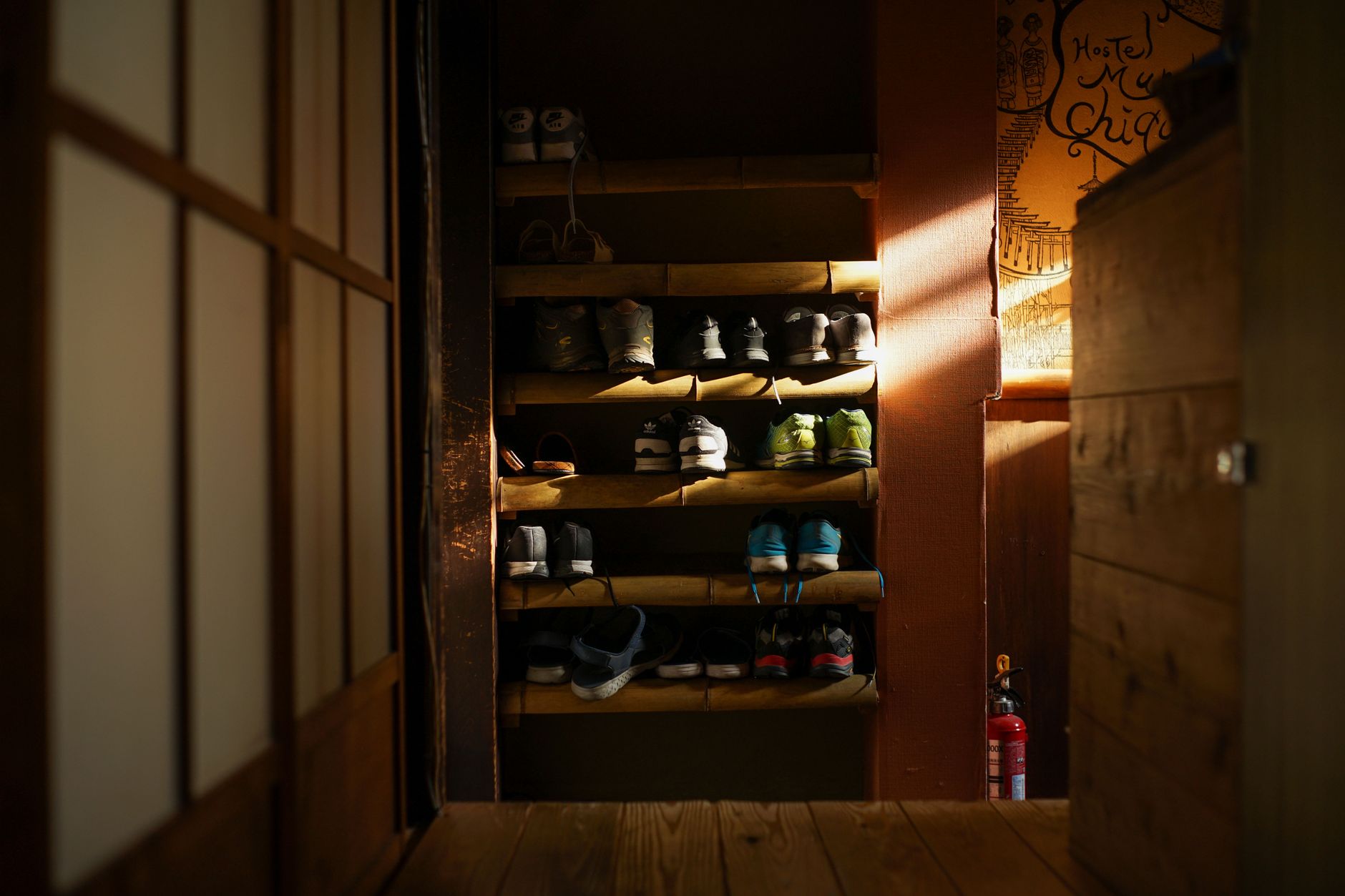
That lower area is the genkan (玄関). It is one of the defining parts of an ordinary Japanese home, but it is also the one you meet first. It is not a foyer or a mudroom, exactly, though it does some of that work. It is the small hard floor just inside the door, before the raised wooden floor of the house begins.
The Step Is the Whole Point
In every genkan I have used, the same physical arrangement repeats. You step up from a hard, shoe-level slab to the main floor. The edge between them is usually finished with wood or stone, and it catches your eye. The house is divided by a change of level, not by a doormat.
That step is what makes the entry work. Outdoor shoes stay on the lower slab. Once you step up, you are inside. The shift in height makes the boundary impossible to miss. You don’t decide to switch shoes because a sign tells you to. The floor does it for you.
What You See Standing in the Door
The genkan has a small set of parts, and most of them are so ordinary that you stop noticing them after a week. The lower floor is usually tile or concrete, easy to clean. The raised floor is wood or something like it. At the edge, there is often a low step or a strip of trim.
The light switch sits before the step, on the wall by the door. That is not a random detail. You can turn the light on while you are still standing in shoes, before you step up. The shoe cabinet, usually a narrow cupboard, sits along one side or built into the wall. Above it or beside the door, there is a small shelf or ledge.
That shelf is where things wait. Packages, a small delivery, the occasional letter. The genkan is a working surface as much as an entry. In my apartment, the delivery person leaves things on the lower slab and I pick them up from the step.
I have written separately about what a Japanese entryway holds besides shoes, because that lower slab becomes a small museum of daily life. Here, the step is the point.
The Boundary You Step Over
The reason the step works is that it is physical. It doesn’t ask you to remember a rule. You can’t walk into the main house without changing level. That makes the crossing impossible to miss. Shoes come off because the floor has changed, and the floor has changed because shoes must come off.
A genkan is not a spiritual threshold. It is a practical one. Outside dirt stays on the lower tile, and inside floors stay cleaner for it. Where I live, it rains enough that wet shoes are a regular thing. A step beats a mat.
The lower slab is treated as outside, even though it is inside the door. That is the part that took me a while to understand. A delivery person stands on the lower slab and talks to you without stepping up. You are both inside the building, but only one of you is in the house. That small distinction is why the genkan works as a buffer.
How It Changes the Day
The genkan shapes small routines you don’t notice until you live with one. You unlock the door, step up, and turn around to close it. You set keys on the little shelf. You sit on the edge once in a while to tie a shoe. The step becomes a seat without being designed as one.
Packages are easy because of that lower slab. A courier can leave a box in the genkan without entering the house, and you can retrieve it without stepping outside. In older buildings, neighbors sometimes leave borrowed things there. The space works as a neutral strip.
Once you step up, you are in the interior proper. That is the part of the house where rooms are separated by sliding partitions like shoji and fusuma, and where floors tend to be wood or tatami. The genkan itself stays hard and low.
Not Every Building Has One
The full-height genkan step is common in houses and older apartments, but it is not universal. Some newer apartments I have looked at reduce it to a shallow tile strip. The floor still changes material, but the level change is small or gone. It is enough for shoes, barely enough for the same boundary.
Buildings that never had a shoes-off rule sometimes skip the step entirely. A hotel room, an office building, a public hall — these may have a flat entry. The genkan is a feature of dwellings, not of every building in the country. I did not know that at first. I half expected a step everywhere.
What American Entryways Don’t Have
Where I grew up, an entryway is a small floor just inside the door. It may have a mat or a rug, but the level usually stays the same. You can walk in with shoes on and nothing physically stops you. The boundary is more of an idea than a surface.
The genkan makes the same boundary unavoidable. The change in level does the reminding. I never had to think about the inside-outside line back home, because it was not built into the floor. Here, I cross it every time I come home, and the step makes the crossing feel like a small event.
The Thing You Learn by Living Here
After a while, the genkan stops being interesting. That is the honest part. You stop noticing the step, the shoe cabinet, the small shelf. It just becomes the place where the day changes. You step down to go out, and up to come back.
What stays with me is the buffer it creates. A stranger can stand at the edge of your home without entering it. That is rare in an American layout. The genkan lets you meet the outside world on the threshold, without giving it the run of the place.
I have never met anyone here who explained the step to me. I learned it by standing in it with my shoes on at the wrong time. The floor taught me. That is the whole design.