
Count the Japanese convenience stores on one Osaka block, and the idea that locations are spaced by need falls apart. There’s a konbini on the corner. There’s another thirty seconds away, on the opposite side of the crossing.
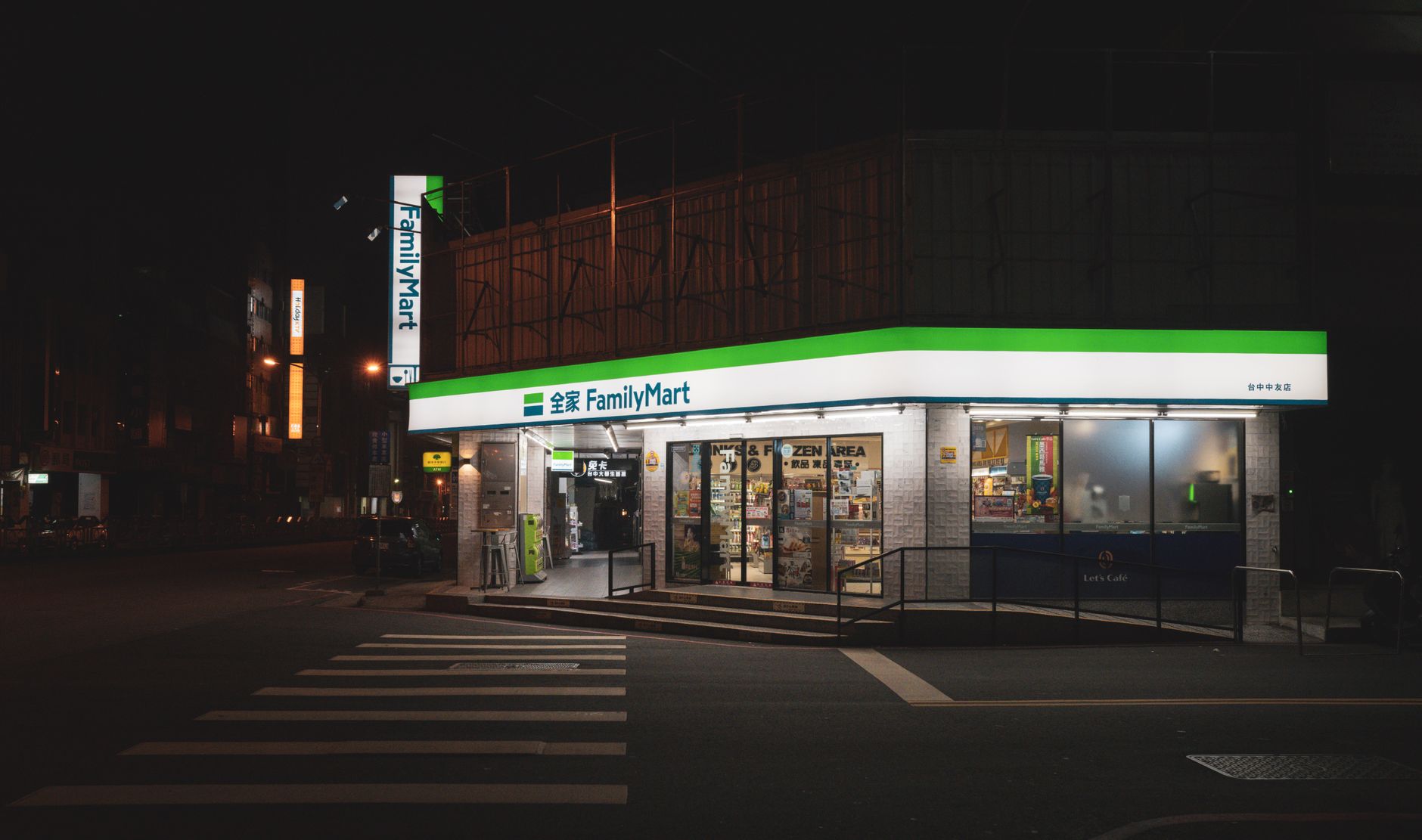
The first time I saw two of the same chain facing each other, I thought one was a mistake. It wasn’t. It was the first hint that I was not looking at a shop count. I was looking at a network.
Konbini (コンビニ) is the everyday word for a convenience store, clipped from English. The word covers a particular kind of shop. The shop is small, open long hours, and stocked for the next few hours of someone’s day.
What a Visitor Notices First
Something about the spacing feels wrong. You pass one store, cross the street, and meet the same chain again. It looks like overbuilding. The numbers suggest the opposite.
Japan’s convenience store sector posted record annual sales in 2025, the fourth year running. That figure comes from the Japan Franchise Association. Total sales rose 2.2 percent year on year to ¥12.05 trillion. Same-store sales rose 1.9 percent to ¥11.58 trillion. Both figures rose, suggesting the sector’s growth was not limited to its existing stores. But the totals alone cannot tell us how much new locations gained from existing ones.
More than 300 new stores opened during 2025. That put the nationwide total at 56,054. The seven largest chains alone operated 56,147 stores as of June 2026. That second number is not every konbini in Japan, only the big chains in the monthly survey.
Visitor numbers crossed 40 million for the first time last year. That helps the sales line. It does not change the reason two stores can stand one block apart.
The density is the part worth explaining. Sales figures make sense once you see that the stores are built for small plots and passing feet. The count is not a mistake.
Why One Block Supports Two Stores
A small footprint lets a konbini operate on plots that would not suit a supermarket or a sit-down restaurant. Whether a particular store is viable depends on more than its size: rent, staffing, sales, and the franchise arrangement all matter.
The small plot is key. A konbini does not need parking the way an American convenience store often does. It needs room for the storefront, a small stockroom, and a place for a delivery truck to stop. That is not much.
The staffing model helps. One or two people can run the whole store in the small hours. The doors stay open through the night without the payroll of a larger operation.
The store does not need a full crew for every hour. The busiest times get more people. The slow stretch in the early morning gets one. That keeps labor costs flat enough for a tiny shop to stay open all night.
A franchise network keeps restocking all day. There is a rhythm to it. Early morning brings rice balls and sandwiches. Afternoon brings desserts and drinks. Evening tops up the dinner items. The store never holds much stock at one time.
Fresh food arriving several times a day is what lets a tiny shop carry more than its floor space suggests. A standalone shop on the same corner could not keep that up. Deliveries stop at the curb. There is no loading dock and no big back room.
Put those factors together with pedestrian flow, and two stores on opposite corners can both make sense. One may catch people walking toward the station, while the other catches people coming from a different direction. That is not a guarantee that both will succeed, but it helps explain why the same chain can appear twice on one short block.
Pedestrian flow matters more than car access. A corner with a lot of passing feet can support a store even if no car can park nearby. That is the opposite of the strip mall model I grew up with.
Here is how I read two nearby stores. One corner catches the morning walk to the station. The other catches the evening walk home. That is my explanation, not a rule. The same customers can overlap, and often do.
What a Konbini Does on a Street
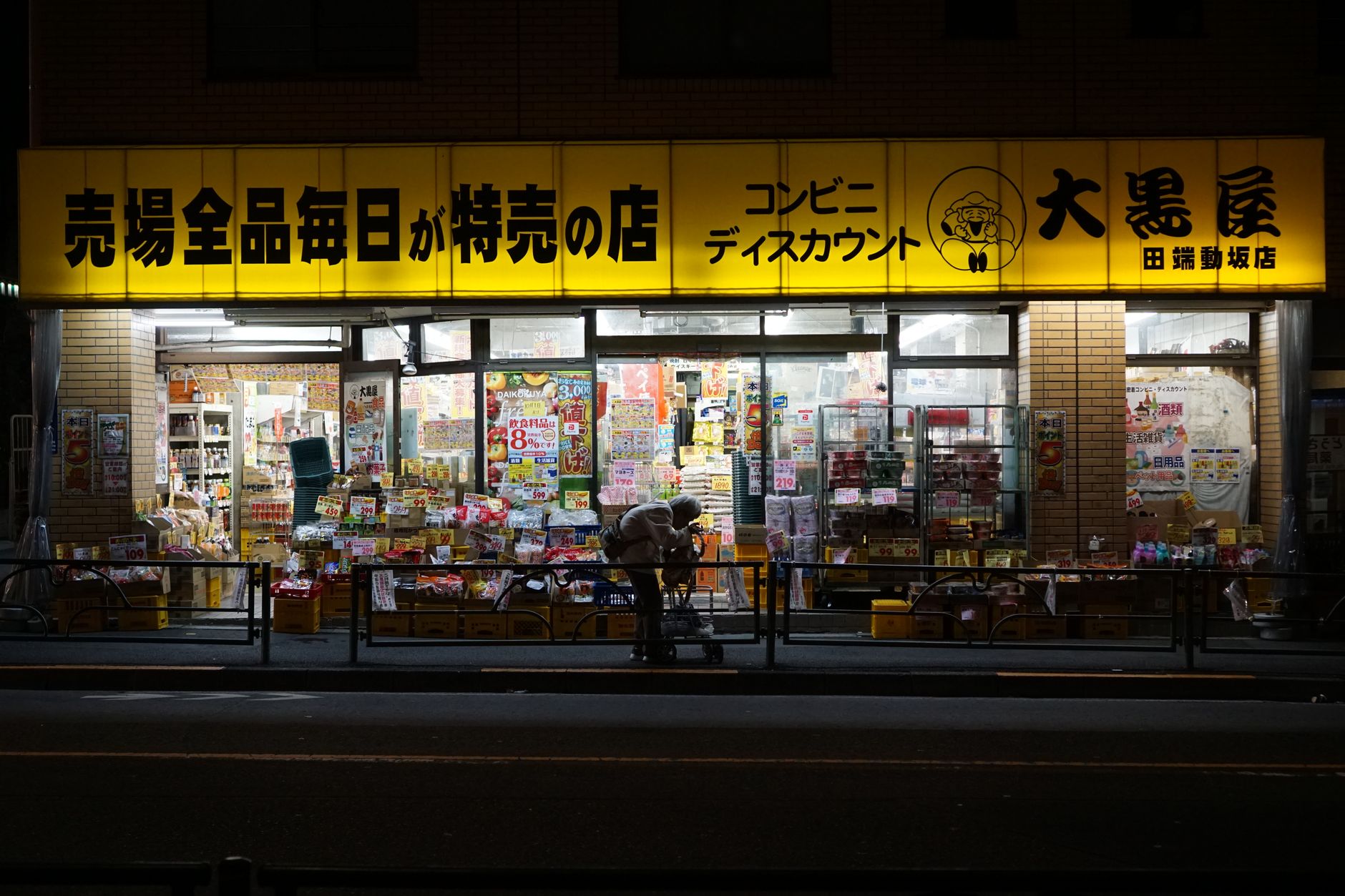
On a quiet street, the konbini can be the latest thing open. It is not a nightlife destination. It is the corner that still has light when the shutters are down everywhere else.
Most people never make a special trip. They pass one on the way to the station, to school, or home from work. The store is built for that passing. The door is placed so the foot traffic does not have to decide.
Nobody says “I’m going to the konbini” the way they might say “I’m going to the store.” It is always on the way. You pass it. You walk in. You leave with one thing.
The colors do the navigating. You turn left at the blue sign and right at the green one. The konbini becomes a landmark as much as a shop.
Because it is open so late, the konbini works as a rough clock. If it is still open, the night has not ended. If the shutters are down, you missed the last thing you needed.
Where I grew up, a corner store was either tied to a gas station or a small independent shop. Most had limited hours. The konbini is closer to both, with the hours of neither. I have a separate article on how a Japanese convenience store is different from an American one.
I am not going to get into the food or the counter services here. Those are their own subjects. This article is about why the stores are everywhere and what that density does on a street.
How the Model Changes Outside the City
The 24-hour sign is not universal. That surprises people. In a big city, it is often true. Step a few blocks over, or out of the city, and the same chain may close at eleven.
The basic model persists. It is still a place to grab one or two items without planning. But outside the city, the hours, range, and role depend on the location. A rural store may close earlier, carry a different mix, or act more like the only shop around.
The same chain can look very different two blocks apart, let alone two towns apart. One store near a station might open all night and sell mostly drinks and ready meals. Another in a residential corner might close by midnight and keep more household basics.
Outside the city, the role can become larger. If the nearest supermarket is a drive away, the konbini may be the only store within walking distance. That changes what it keeps and when it closes.
I have to be careful here. It would be easy to say rural stores keep the same hours and the same shelves. They don’t. The model stays. The details bend to the place.
What the chains do now tells you where their attention is going. Major chains are rolling out new services to pull customers in, amid a general decline in store traffic.
FamilyMart opened a flagship in Azabudai, Tokyo, built around apparel. It carries about 300 items and has a layout roughly 1.5 times a typical outlet.
That does not mean the neighborhood konbini is disappearing. It means the chains have already covered the easy corners and are looking for the next reason to draw a customer in.
The next time you pass two of them on one block, you will know what you are looking at. It is not excess. It is the cheapest way to put a store exactly where the feet are.
References
- MobilityPlaza — record annual sales, store count and growth, and visitor figures.
- The Japan News — chains adding services amid declining store traffic, and the FamilyMart flagship details.
- Beika Mochi — the seven-chain member store count and its caveat.