
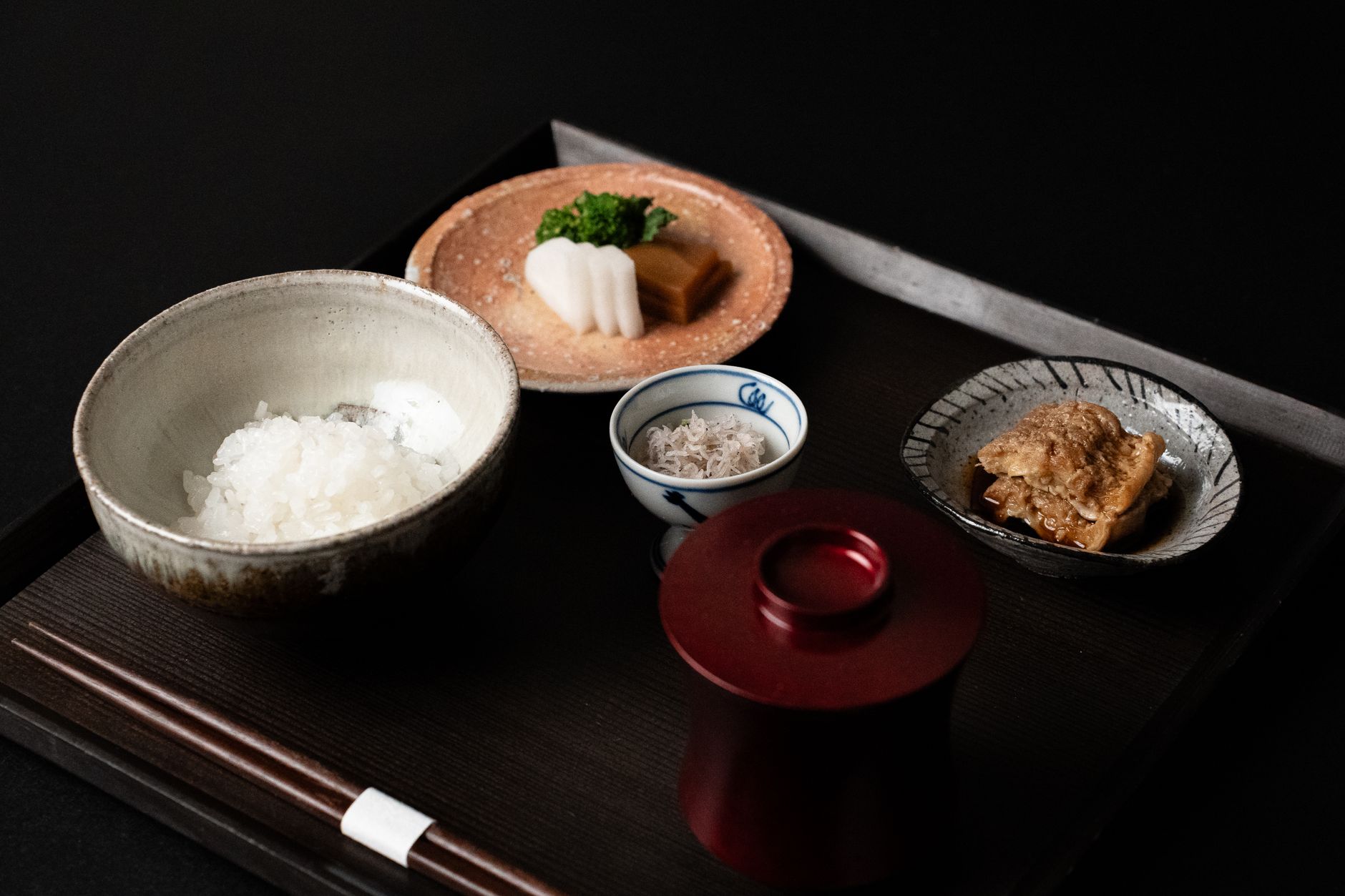
A Japanese dinner in people’s homes doesn’t show up as one heaped plate. Not the ones I’ve sat down to, anyway. The table fills with small bowls and little plates. Some hold two bites of fish. One holds a few pickles. Rice arrives in its own small bowl, untouched by anything else.
The Shape Most Home Dinners Take
Many home-cooked dinners follow a loose pattern called ichiju-sansai (一汁三菜). It means one soup and three dishes. The soup is usually miso. Around it sit a bowl of rice, a small main dish, and two smaller side dishes. The soup might be clear instead of miso on some nights.
A Japanese breakfast follows the same small-bowl logic, though the dishes change. The dinner version mostly swaps grilled fish and pickles for an egg, a piece of fish, or simmered vegetables. The pattern is not strict; nobody counts the plates. Nothing on the table is large.
The main dish is often a modest piece of fish, a few slices of meat, or an egg dish. The side dishes might be simmered vegetables, cold spinach, or pickles. The pickles are often store-bought, not made at home.
The Main Dish Is Not the Main Event
An American dinner usually centers on one big thing — the steak, the roast, the casserole. The starch and vegetables come along around it. Home dinners in the homes I’ve eaten at don’t work that way. A large shared roast is not a thing I have seen on an ordinary weeknight.
The rice bowl is the constant. It sits directly in front of each person. The small plates orbit it. A main dish might be one grilled fish, split among three people. That takes a bit of getting used to. The main dish can disappear in three or four polite passes.
Because the protein portion is small, the meal doesn’t stall when it is gone. Rice and soup keep the table moving. The small dishes get passed again. That is the part an American guest may not see coming.
What a Guest Notices First
The table looks busy, but every thing on it is small. You get your own rice bowl and your own miso soup. The other plates sit in the middle and get shared. You take a little at a time. The first few times, I was not sure whether to reach or wait.
In the homes I’ve visited, people often use the back end of their chopsticks to take from the shared plates. No one passes around serving spoons. The food moves clockwise, or to whoever hasn’t had any yet. It feels less formal than it sounds once the table moves.
The first thing I noticed was how much of the table belonged to nobody. The bowls in front of you are yours. The rest is communal, and everyone seems to know the difference without being told. A small plate can feel like a private portion even when it sits in the middle.
Portions, Seconds, and the Empty Bowls
A first serving looks modest. The rice bowl is usually filled level, not heaped. The soup has a few small pieces of tofu or seaweed at the bottom. Each shared plate holds just a couple of bites per person. Nothing arrives as a heaping platter.
But dinner does not end when the small plates are clean. Rice and soup get refilled if you want them. In many homes I’ve been in, a second bowl of rice is normal. The shared dishes are not refilled. Asking for more rice is easy; asking for more fish is not.
The soup bowl is small enough to lift and drink from. I learned that by watching, not by asking. It sits to the side and gets finished in a few quiet swallows. The soup is warm enough to hold, but nobody treats it as a full course.
What’s Usually Missing
Most home dinners I’ve joined have no bread, no big salad, and no dessert course. The meal often ends when the last rice bowl is empty and the tea is poured. No one brings out a basket of rolls.
A sweet course is rare on an ordinary weeknight in the homes I’ve eaten in. If anything follows, it might be a piece of fruit. The kitchen cleanup starts while people are still finishing their soup. Fruit is not a course; it is a quiet way to close the meal.
There is also no appetizer before the meal. Nobody waits for the food to arrive in stages. Once the rice and soup are on the table, dinner has started. Dinner often ends with everyone still at the table, not moving to another room.
The Practical Reason for All the Small Plates
My guess is the separate bowls come from how the food is made and stored. A little fish here, some pickles there, and a pot of rice and soup each keep their own amount. Each thing keeps its own identity. The bowls are also easier to wash than a stack of serving platters.
That also makes leftovers simpler. Tomorrow’s lunchbox can take a bit of this and a bit of that without rearranging a whole plate. I’ve never found a single explanation that settles the origin, and nobody I’ve asked has either. The system rewards cooking once and eating in pieces.
The small plates also mean the cook can add one new thing without changing the rest of the table. If there is a new pickle tonight, the rice and soup stay exactly as they were. A new dish does not disturb the rest of the meal.
When the Table Shrinks
On a busy weeknight, the three side dishes drop to one or two. The rice and soup stay. A single pan of stir-fried vegetables or a few slices of cold tofu might stand in for the whole spread. It still counts as dinner.
The logic does not change. The meal still has rice, still has soup, and still has something to eat with the rice. It just has less to pass around. Some nights the whole meal is rice, soup, and one shared plate.
When Guests Come, the Table Changes a Little
With company, the same shape holds, but every category gets a little fuller. There might be two main dishes instead of one. The pickles come in three small bowls, not one. A little more of everything, but the same map.
The plates still get shared, and the rice still anchors the table. The difference is mostly pace. A guest dinner lingers longer, with tea refills and more empty dishes in the sink. The extra dishes make the table look fuller than it is.
Even with a fuller table, nobody calls it a feast. The word dinner still means rice, soup, and a few small things. It just takes longer to clear away. I have never seen a home dinner end with a dramatic final course.
What It Looks Like From Where I Sit
After a while, the small plates stop looking sparse. They look like a normal dinner. You get a bowl of rice and a bowl of soup. A few bites of something savory sit next to a few bites of something pickled. The table feels settled, not sparse.
Back home I grew up filling one plate and picking at it while it cooled. Here, the table stays busy the whole meal. You eat a little, pass a plate, pour some tea, then take another bowl of rice. It is a different rhythm from one-plate eating.
I used to wait for a main course to arrive. Now I understand there is no course. The meal is the whole table, and it moves all at once. Now the small plates read as abundance, not absence.