
The first apartment I looked at in Osaka had a bedroom labeled “6 tatami.” I knew tatami were the straw floor panels. But a room size in mats? That made about as much sense as measuring a kitchen in bath towels.
What a Tatami Is
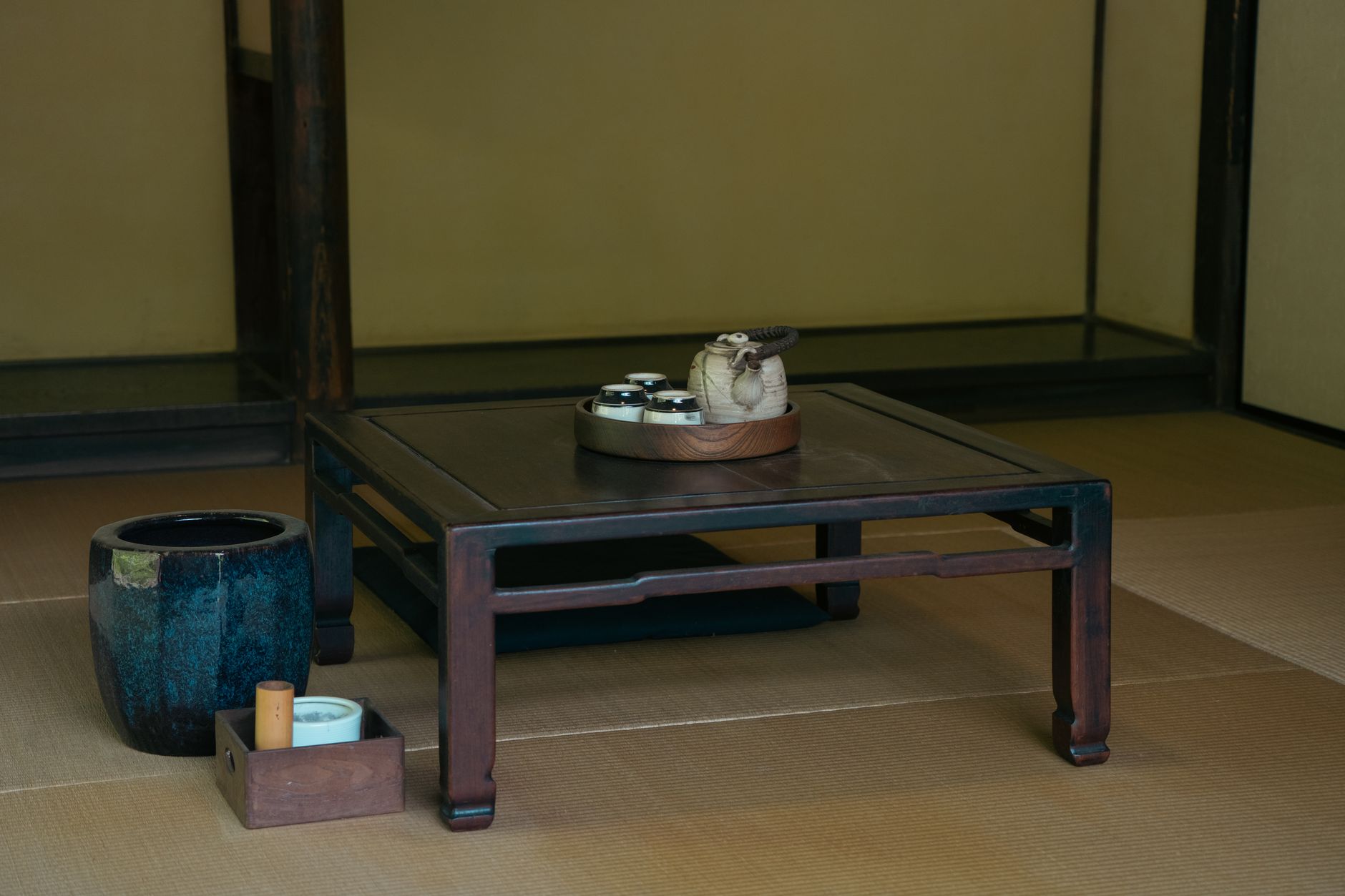
A tatami (畳) is a floor panel, not a rug. It has a core made of pressed rice straw and a cover woven from soft rush. The edges are bound with a strip of fabric. The panel is dense. It feels firm underfoot but gives just a little. New ones smell like dry grass.
The mats are modular. A room’s floor is made of several identical panels fitted side by side. You notice the seams when you walk across one. It is a little like standing on a firm, woven mattress, not a carpet.
The English word “mat” makes tatami sound portable. That’s the one misleading part. A tatami is not rolled up and put away. It is the floor itself, built into the room piece by piece.
The cloth edges are usually dark green or black. That trim hides where the cover meets the core. Over time it frays first. You can read a room’s wear from its corners.
A new tatami is pale green and stiff. After a year it softens and turns a more golden brown. The straw smell fades slowly. That change is normal, not dirt.
A tatami is also sized around people, not furniture. A room that fits six mats can feel generous for sleeping. It gets cramped with a desk, a chair, and a bed. The mat count gives a body-scale, not a furniture-scale.
Why Floor Plans Count Mats
Almost every rental listing here marks rooms in mats, not square meters or feet. A bedroom might be six tatami. A living room might be ten. This is everyday shorthand, and it works because the mat is close to the size of one person lying down.
The usual explanation I have heard is that rooms were once built to hold a set number of mats. The count became shorthand. I have not seen that documented, and it may be one of those practical things nobody wrote down.
In the US, I grew up thinking in square feet. A 12-by-14 bedroom had a number with two digits. Japan does something similar with furniture-sized units. One mat is about the floor space a person takes up. That mental image is more useful in person than it sounds on paper.
The count is not exact math. A six-mat room is a room that fits six mats. A four-and-a-half-mat room has four full mats and one half mat cut to fit. The half is often placed near a narrow edge or a doorway. It is a layout detail, not a precise survey.
Rental listings do include the square meter number, usually in small print. But the mat count comes first. A six-mat room gives you a faster mental picture than 9.9 square meters. One number sounds like a floor. The other sounds like a spec sheet.
The count also carries room-shape hints. A long, narrow six-mat room and a square six-mat room can hold very different furniture. The number only tells you the approximate area, not the shape.
There is a practical reason the mat count survives in rental ads. It lets you picture lying down in a room. Square meters do not offer that. Once you know your own body is roughly one mat, a six-mat room stops being abstract.
How Mats Fit a Room
Most rooms are arranged in a grid of full mats. Corners and alcoves get a half mat cut to size. In older wooden homes, a mat might even be trimmed around a pillar. The seams become part of the room’s grid.
The arrangement matters because rooms are measured in mats, not mats measured by room. The grid is the floor. That is why a room can have 4.5 tatami and still read as a real number to a local.
The grid is not just for looks. The seams tell you where the full panels begin and end. In some older places, the border pattern shifts when a half mat sits beside a full one. It is the kind of detail you stop seeing after a while.
A Mat Is Not a Fixed Size
After a while I noticed the same count looked bigger in some apartments than others. At first I blamed my memory. Then I learned the mat itself changes depending on where you are.
In the Kyoto area it runs larger than in Tokyo, and in apartment buildings it can be smaller again. I don’t have a source for the exact dimensions, so I’ll skip the numbers. A six-mat room in Osaka is not the same floor area as a six-mat room in Tokyo.
Most listings do not volunteer which standard they used. You only find out from the fine print or by standing in the room. That makes the mat count a local habit, not a national unit. Two people in different cities can use the same number and mean different amounts of floor.
I stopped comparing apartment sizes across cities using mat counts alone. The number is useful for a single listing. It is much less reliable for a ranking.
The regional difference shows up most when people move. Someone from Osaka reads a Tokyo listing and assumes a six-mat room is the same as home. It is not. The apartment may say the same number and feel smaller.
There are even names for these standards if you go looking. A Kyoto-style mat is bigger than a Tokyo-style mat, and an apartment-grade mat is smaller still. But most renters never learn the names. They just notice the room feels different.
What They’re Like to Live With
You do not wear shoes on tatami. The same rule that applies to the rest of an ordinary Japanese home matters more here. The rush cover traps dirt and wears down under hard soles. Slippers are usually fine. Bare feet or socks are more common.
Furniture digs in. Chair legs and low tables leave dents unless they sit on small pads. Sunlight fades the color too. I learned that after sliding a table across the room and finding a brighter rectangle where it had been.
Sound changes on tatami. Footsteps are quieter. The room feels a little warmer underfoot in winter. The trade-off is care. A spilled cup of coffee soaks in fast and leaves a stain if you wait.
In summer, the mats in my apartment can hold a slight dampness. In winter, the edges sometimes dry out and pull away near the wall. Neither one is a crisis. Both are just part of living with a natural material.
A tatami room rarely opens straight outside. There is usually an entryway or a genkan in between, even in small apartments. That buffer keeps the rush cover from meeting the street all at once.
Tatami rooms often connect through sliding partitions rather than hinged doors. The panels slide on a track and lift out entirely. That is why older apartments can feel like one room. The walls are something you move, not something fixed.
What the Count Actually Tells You
Six tatami ended up meaning something simple to me: room for a person, a low table, and not much else. The number was never exact. It was local shorthand, and once I stopped expecting it to be precise, it worked.
If someone gives you a mat count, treat it as a rough body-sized guess. It tells you whether the room is a closet, a bedroom, or a living area. The exact area lives in the fine print, and the real test is still standing in the room.